

In 2025, Hong Kong’s unemployment rate stood at about 3.7%, close to pre-pandemic levels. However, for many young graduates, finding a stable job after university remains uncertain. While official data points to labour market recovery, students entering the workforce often face challenges that headline figures alone do not fully capture.
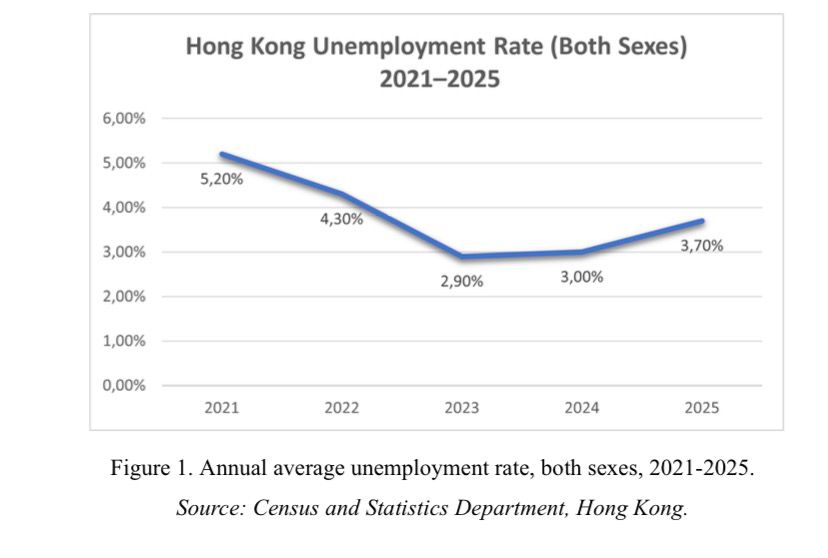
As shown in figure 1, Hong Kong’s unemployment rate fell sharply after reaching its peak in 2021 and then stabilised in the following years. From a macroeconomic perspective, this trend points to a recovering labour market. However, overall unemployment figures do not affect all groups in the same way. For young people entering the workforce for the first time the situation remains less stable. While unemployment among the general population has stayed relatively low, youth unemployment presents a different picture.
Data released by Hong Kong Census and Statistics Department and compiled by market analysts, shows that the unemployment rate for people aged 20 to 29 stood at around 6.9%, almost double the overall unemployment rate. Although this figure is lower than during the pandemic years, it still highlights the difficulties many young people face when starting their careers. For many students, these figure are not just statistics but reflect their everyday concerns about future employment. Vickiey, a final year journalism student at Hong Kong Baptist University (HKBU), described the situation faced by many of her peer who are preparing to enter the job market. “For journalism students like us, job opportunities are quite limited, and the starting pay is relatively low,” she said. “It’s really difficult to enter big companies in the first year after graduation.”
At the same time, the media industry in Hong Kong has undergone notable changes. Many traditional news organisations have streamlined operations and reduced entry‑level hiring, while others have shifted towards leaner, digital‑focused models. As a result, stable entry‑level positions for fresh graduates have become more limited, making it harder for newcomers to secure long‑term employment despite signs of overall economic recovery. In response, universities have taken on a more active role in preparing students for work. Internship programmes, student‑run media platforms, and applied learning opportunities have become essential in helping students gain practical experience before graduation. For many young people, universities now serve not only as places of academic learning but also as important bridges between education and employment. Alongside university‑level support, government policy has also become part of how young graduates navigate their early career options.
One such initiative is the Greater Bay Area (GBA) Youth Employment Scheme, which encourages Hong Kong graduates to take up job opportunities in Mainland cities through placement support and employer incentives. For many young people, the scheme represents an alternative pathway to gain initial work experience outside the highly competitive local job market. For students like Vickiey, the scheme offers an additional option rather than a permanent relocation. “Apart from school support, there are also government policies to encourage fresh graduates to work,” she said. “The Greater Bay Area (GBA) Youth Employment Scheme offers job opportunities and a monthly allowance, which can be helpful for young people who want to gain work experience.” This policy focus illustrates how the Greater Bay Area (GBA) Youth Employment Scheme operates primarily at the individual level. Rather than addressing unemployment at the national scale, the scheme is designed to support early career transitions by providing financial incentives to enterprises and facilitating job placements for young people in Mainland cities. Through this approach, participants are able to gain work experience, income stability, and cross border exposure during initial stages of their careers. This argument is further supported by programme data showing that as of February 2025, more than 2,262 young graduates had been employed through the scheme, with participation from 1,076 enterprises. Among those who completed the 18 month placement period, around 73% continued working after the subsidy ended. These figures indicate that the programme is relatively effective at the individual level, even though its scale remains insufficient to significantly alter Hong Kong’s overall unemployment rate. In conclusion, this discussion highlights how individuals (students), institutions (universities), and policies (the GBA Youth Employment Scheme) interact in shaping early career outcomes.
While students navigate limited opportunities and universities prepare graduates for the labour market, targeted policies like the GBA scheme provide additional pathways that can ease school to work transitions. Together, these three levels demonstrate that addressing youth employment challenges requires not only macroeconomic recovery, but also coordinated support across individual, institutional, and policy dimensions. furthermore, addressing similar challenges regarding limited job opportunities and low wages in the media sector, Vickey’s as a journalism student in Hong Kong, highlights that the synergy between educational institutions and governments policies is crucial for sustaining the career prospects of young graduates. At the academic level, universities like Hong Kong Baptist University (HKBU) take a proactive role by providing direct practical experience through programs such as the broadcast news network, allowing students to produce and publish their own work as professional preparation before graduation. However, support extends beyond the classroom the Hong Kong government also intervenes through strategic initiatives like the Greater Bay Area Youth Employment Scheme.
This program not only expands career horizons for fresh graduates into mainland Chinese cities but also offers financial incentives in the form of monthly allowance to alleviate economic pressures at the start of their careers. Through this combination of practical readiness from university and financial backing from the state, young professionals are encouraged to remain optimistic and contribute effectively, even within a highly competitive industrial landscape. This context helps explain why Vickiey’s concerns are highly reasonable, even before she officially graduates. Although she is still a final-year student, the pressure to prepare for a career has already emerged at an early stage. Uncertainty in securing employment is no longer something that begins after graduation, but has become part of student’s experiences during their university years. In an increasingly selective job market, competition at the entry level has become more intense. Limited positions mean that fresh graduates are not only competing with their peers, but also with candidates who already possess prior work experience. In this environment, an academic degree alone is no longer sufficient to secure employment oppourtunities. This situation is closely linked to changing employer expectations. Many organisations now prioritise candidates who have practical experience, even at an early stage of their careers. In addition, the ability to work across multiple platforms particularly in the increasingly digitalised media industry has become a significant advantage. Graduates are expected not only to have fundamental journalism skills, but also to adapt to digital content production, multimedia practices, and cross platform distribution. The combination of intense competition, rising skill demands, and limited job opportunities has led to career pressure emerging well before graduation. In this context, Vickiey’s concerns are not merely personal anxieties, but rather a reflection of broader structural challenges faced by many students in Hong Kong today. Amid Hong Kong’s broader economic recovery, developments in the labour market point to a more cautious hiring environment across industries, including media.
Employers are increasingly prioritising efficiency and targeted recruitment, reflecting ongoing restructuring and the growing influence of digital technologies. A report by “KPMG Hong Kong Employment Outlook 2026” highlights that organisations in Hong Kong are focusing on cost control and selective hiring rather than broad expansion, indicating a shift in workforce strategy. Within this context, the media industry has changed, as many organisations streamline operations and adopt leaner, digital-focused models to adapt to evolving audience behaviour. These shifts have created a more challenging environment for new entrants. With companies becoming more selective and cautious in hiring, opportunities for fresh graduates are increasingly limited, particularly at the entry level. As a result, the job market has become more competitive, and entry-level opportunities have narrowed, making it harder for graduates to secure stable positions despite overall economic improvement. This gap helps explain why many young job seekers continue to face uncertainty during the transition from university to work.
In conclusion, while Hong Kong’s headline unemployment rate suggests a stable and recovering economy, the lived experiences of fresh graduates reveal a more complex reality beneath these figures. The contrast between relatively low overall unemployment and higher youth unemployment highlights a gap that statistics alone cannot fully explain. For many young people, the transition from university to work is no longer a straightforward progression, but a more uncertain and competitive process shaped by limited entry-level opportunities, evolving industry demands, and cautious hiring practices. Within this increasingly complex landscape, the role of individuals in building adaptable skills, the role of universities in bridging education and practical experience, and the role of targeted policies in supporting early career pathways all become equally important. Together, these elements underscore that addressing youth employment challenges requires not only economic recovery, but also coordinated efforts that respond to the realities faced by graduates entering the workforce today.


Leave a Reply